

Golden Retriever

When you are playing tennis and you are not so good at it, you often have to pause the game to collect your balls again. We solved this problem by creating the Golden Retriever. This fully autonomous robot locates and picks up tennis balls and hands them to you when you command it to.
Since I find myself to be a more technically focussed industrial design engineer, I got really excited when I had the possibility to apply for the minor Robotics. I have been fascinated with robots since I was a little kid, so this was an easy choice.
The project is done in a group consisting of multiple disciplines: two mechanical engineers, one electrical engineer, two programmers and of course me. Within the group, I functioned as project leader. I was keeping close contact with the electrical and the mechanical engineers and made sure the design would fit together in the end. While we were advancing through the design process and everybody focussed on their own discipline, I was assigned to design and produce the outer shell of the robot. While the inner frame consisted mainly of standarized parts, which were mostly orderable online, the outer shell was 100% custom. I wanted the robot to look slick and smooth, but also small. The goal of the robot was to prolong tennis games, so we did not want the robot to distract the player. As the American architect Louis Sullivan once said: Form follows function. We kept it minimal.
The first three months we used for designing and calculating everything about the robot. The second three months we used for building and testing the prototype. I created the outer shell using 3D milling of foam and then vacuum forming a sheet of plastic over it. This proved to be a real challenge, since I wanted to use as less plastic sheets as possible and thus designed the shell to be as close to the machine boundaries as possible. This resulted in some shapes which were quite challenging to create. At this point, I learned very much about this production technique. The shell was mounted to the frame using 3D printed shackles, which were glued to the shell.
In the end, we managed to get the robot functioning! It still had to be tweaked a lot, but it worked! The robot was able to follow the player (which was wearing a recognizable suit) with its turret camera, and at the same time it scanned for the yellow colour and round shape of the balls with its front camera. By driving over the ball, it was able to pick it up and store it in the storagespace. Upon pressing a remote, the robot would turn itself to the player it had been following and shoot a ball at it.
Sadly, the project had to end. With a lot of hours put into it, we finally were able to present it to the public at the minor exhibition at the faculty of Industrial Design Engineering. A short item of TV-West about it can be found below.
-
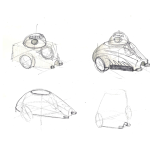
- Early stage design sketches of the main shape of the robot.

-

- Early stage design sketches of the main shape of the robot.

-

- Early stage design sketches of the main shape of the robot.

-
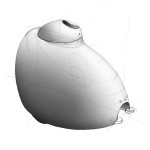
- Early concept art of the main shape of the body.

-

- Early concept art of the main shape of the body.

-

- Render of the 3D model of the Golden Retriever.

-
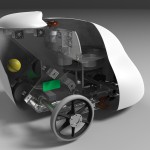
- Render of the 3D model of the Golden Retriever.

-
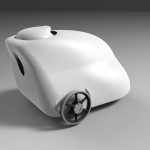
- Render of the 3D model of the Golden Retriever.

-
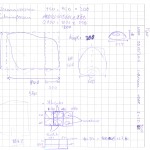
- Measurements and calculations of the prototype shell.

-

- The almost complete Golden Retriever at our workbench.

-

- Last minute tweaking at the minor presentation. Photo by Guus Schoonewille

-

- Photo render of the Golden Retriever in it’s use environment.
-
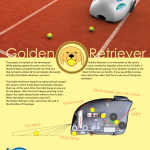
- Informative poster explaining the main use of the Golden Retriever.

See our project on the TV West news (from 15:50)
And on the website of the TU Delft
This robot was created for the minor Robotics 2014-2015. This project was sponsored by TU Delft, 42 and IDEOMA.